
Outsourcing Marketing Department Deployment Process Associated with Sales KPI
Businesses invest budget in advertising, content and many communication channels but it is still difficult to determine which activities actually create customers? The cause sometimes does not lie in budget or personnel, but comes from the lack of a unified marketing process and clear measurement system.
For Marketing to contribute to business growth, businesses need to determine goals from the beginning, assign specific responsibilities and monitor effectiveness throughout the implementation process.
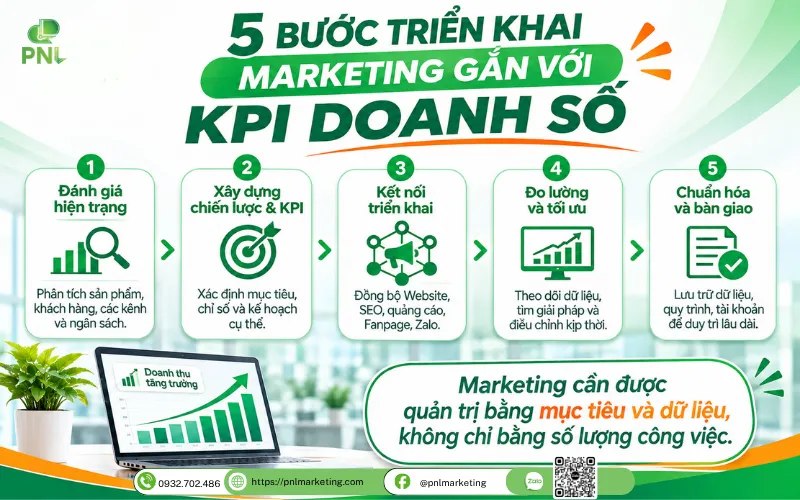
1. Evaluate the current status and determine business goals
Before starting, you need to understand where your business is and what you want to achieve.
Some contents that need to be evaluated include:
- Products, services and competitive advantage.
- Target customers and purchasing behavior.
- Current status of website, fanpage, advertising and access channels.
- Marketing budget and internal resources.
- Process of receiving, consulting and converting customers.
From this data, businesses and implementation teams agree on priority goals: increase awareness, generate leads, increase orders or improve conversion rates.
The more specific the goal, the more foundational it is to build KPIs and evaluate effectiveness.
2. Build appropriate strategies and KPI systems
The same set of KPIs should not be applied to every business. The index needs to come from business goals, product lines, budget and the conversion capacity of the sales team.
KPIs can be divided into groups:
- Reach KPI: website visits, reach, interactions.
- Lead KPIs: number of contacts, sign-up forms, calls or messages.
- Conversion KPI: Ratio of leads to sales opportunities, close rate.
- Business KPI: revenue recorded from campaigns, cost per customer and investment efficiency.
The important point is to unify the way data is recorded. For example, a customer leaving information on the website needs to be tracked to consultation and purchase results, instead of just being counted as a conversion.
3. Assign deployment and connection of Marketing channels
After agreeing on the strategy, activities need to be implemented according to plan and have a specific responsible person.
Tasks usually include:
- Building content on websites and social networks.
- Implement SEO, advertising and customer attraction activities.
- Set up information reception points on website, fanpage or Zalo.
- Connect customer data with consulting and sales processes.
- Monitor progress and quality of each activity.
The external team needs to coordinate with internal personnel to clearly understand products, sales policies and customer feedback. If Marketing and business operate separately, the increased number of potential customers may not necessarily generate corresponding revenue.
4. Monitor KPIs, report and optimize continuously
Marketing should not only be evaluated at the end of the month. Businesses need to have a periodic monitoring mechanism to detect problems and make timely adjustments.
For example:
- Visits increase but few people leave information: need to check content and conversion experience.
- There are many potential customers but low closing rate: need to coordinate with the sales department to evaluate customer quality and consulting process.
- Advertising costs increase: need to review customer files, messages and effectiveness of each campaign.
Reports need to show actual results, causes of differences compared to goals and next actions. This is the basis for businesses to control their budget instead of just looking at the number of posts or interactions.
5. Standardize processes and transfer knowledge
An effective marketing system should not depend entirely on one individual or group of personnel.
Businesses need to be handed over plans, data, accounts, operating procedures, reports and related documents. At the same time, internal personnel need to be guided to coordinate, receive and maintain activities.
This is also a factor that helps businesses limit disruption when changing personnel or adjusting deployment models.
PNL Marketing accompanies building a Marketing system associated with business goals
PNL Marketing approaches the Marketing problem from the current status and growth goals of the business. Instead of just focusing on each individual task, the solution aims to connect strategy, content, website, communication channels, customer data and measurement activities.
KPI is built according to goals and actual conditions, with methods for monitoring, evaluating and optimizing during implementation. Businesses also need to standardize processes and receive data so that Marketing activities can be maintained in the long term.
Is your business implementing Marketing but not controlling its effectiveness? Start by assessing the current status and determining the indicators that truly reflect your business goals.
Contact PNL Marketing to jointly build a Marketing solution suitable to the resources and development orientation of the business.
-----------
🚀 PNL – Upgrading your business
📞 Hotline: AI assistant - 039 86 52281 / or expert 0932 702 486
💻 Software website: https://pnlsoftware.com.vn
🌐 Marketing solution website: https://pnlmarketing.com/
💬 Zalo OA: https://zalo.me/chuyendoisopnl
📱 Tiktok: @pnlchuyendoiso
🛍️ Miniapp Zalo store template: https://shop.pnlmarketing.com/