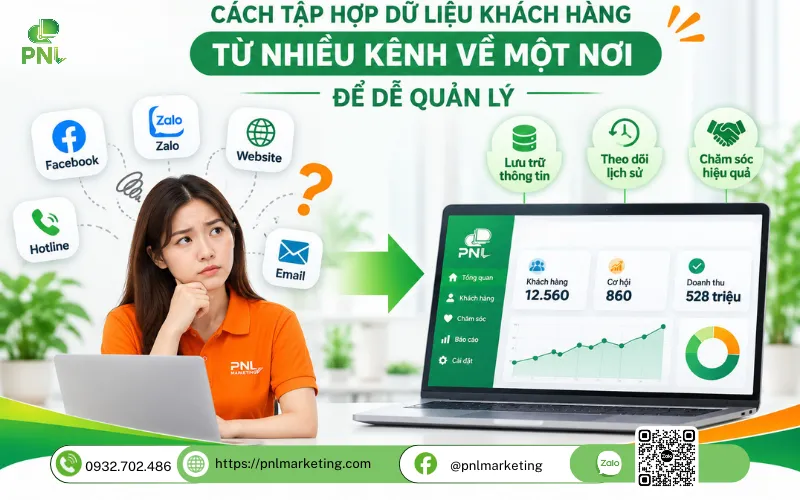
Customers contact through many channels but information is scattered on Facebook, Zalo, Website, Excel and staff phones. This makes it difficult for businesses to track, easy to miss information, and takes a lot of time to synthesize. Centralizing customer data on one system helps businesses manage information throughout, reduce manual operations and be more proactive in customer care.
Customers can know the business through the website, message the price on Facebook, continue to discuss via Zalo and then decide to buy. But where is their information being saved? Part of it is in the fanpage message, part of it is on the employee's Zalo, the other part is recorded in an Excel file or saved in a personal phone.
As the number of customers increases, searching and synthesizing information from many places becomes a burden. Employees waste time checking each channel, the new person in charge does not know the exchange history, and it is difficult for business owners to know how far customers have been consulted. The problem is not that businesses have too many sales channels, but that there is no way to manage data throughout those channels.
1. What problems does distributed customer data cause?
For small businesses, using Facebook, Zalo, Website and Excel to manage customers can be quite convenient at first. However, as business activities expand, this approach gradually reveals many limitations:
- Difficult to find customer information: Employees have to open each platform to find previous messages, phone numbers, needs or consultation content. If you don't remember where the customer contacted you, looking up will take more time. - Duplicate information: A customer can message via Facebook, then call or leave information on the Website. If there is no way to compare, businesses can save into many different records. - Lack of continuity of care: The reception staff later does not know what advice the customer has received, what products are interested in or where there are still problems. Customers have to repeat their needs, and businesses easily miss the opportunity to continue the exchange. - Difficult to evaluate the effectiveness of each channel: When data is not collected with customer data, it is difficult for managers to determine which customer sources are bringing many quality contacts, which sources have good conversion rates to allocate resources appropriately.
2. Steps to gather customer data in one place
Businesses do not necessarily need to invest in a complex system from the beginning. It is important to determine the information that needs to be managed, agree on how to record it, and choose tools appropriate to the scale of operation.
Step 1: Identify the sources of customers being received First, businesses need to list the places where customers often contact: Facebook, Zalo OA, Website, hotline, stores, events or other sales channels. This helps businesses know where the data is located and which sources need to be prioritized for connection.
Step 2: Standardize the information that needs to be stored Not all information needs to be collected. Businesses should start with essential data such as full name, phone number, contact source, needs, products of interest, staff in charge and communication history.
Step 3: Use a centralized management system Instead of letting each employee save their own data, businesses can use a centralized customer management system. Depending on the platform and configuration, the system can support connecting receiving sources, saving customer information and recording interaction history in the same place.
This is where CRM software comes into play. CRM is not simply an electronic directory, but helps businesses track information, communication processes and customer care status. Businesses need to check actual connectivity before choosing.
Step 4: Set up a process for updating and using data Having a system is not enough. Employees need to know when to update information, who is responsible for handling it, and how to record results after each interaction. Businesses should also assign appropriate access rights and periodically check data.
3. How does PNL support businesses in managing customer data?
For businesses that are receiving customers from many channels but do not have a unified management method, PNL aims for a solution that connects tools with actual operating processes.
PNL Marketing can accompany businesses in reviewing data sources, determining customer reception and care processes, and advising on plans to connect appropriate channels. Regarding software platforms, PNL Software provides technology solutions for data management and business operations. Depending on the needs, businesses need to be specifically evaluated to choose the appropriate tools and configuration.
The goal of collecting customer data is not only to bring data to one place, but also to help businesses proactively hold customer information, reduce dependence on individual operations and maintain consistent care activities.
4. Conclusion
When customers come from many platforms, managing each individual mailbox, Excel file and phone will become increasingly difficult to control. Collecting customer data is an important step for businesses to save time, limit information loss and improve care quality.
Businesses do not need to start with a very large system. Let's start from understanding where the data is located, what needs to be managed and choose a solution that can grow with the scale of the business. PNL Marketing accompanies businesses to build customer management and operations solutions on a centralized data platform, suitable to actual needs. ----------- 🚀 PNL - Enhancing businesses 📞 Hotline: Chatbot AI - 039 86 52281 / or expert 0932 702 486 💻 Software website: https://pnlsoftware.com.vn 🌐 Marketing solution website: https://pnlmarketing.com/ 💬 Zalo OA: https://zalo.me/chuyendoisopnl 📱 Tiktok: @pnlchuyendoiso 🛍️ Miniapp Zalo store template: https://shop.pnlmarketing.com/
As the number of customers increases, businesses are susceptible to fragmented data, overloaded employees, and missed sales opportunities. CRM software helps centralize information, track the consulting process and manage customer care activities.