Era of AI Search: Is Website Helping Businesses Be Recognized by AI?
-----------
🚀 PNL – Nâng tầm doanh nghiệp
📞 Hotline: Trợ lý AI - 039 86 52281 / hoặc chuyên gia 0932 702 486
💻 Website phần mềm: https://pnlsoftware.com.vn
🌐 Website giải pháp Marketing: https://pnlmarketing.com/
💬 Zalo OA: https://zalo.me/chuyendoisopnl
📱 Tiktok: @pnlchuyendoiso
🛍️ Miniapp Zalo store template: https://shop.pnlmarketing.com/
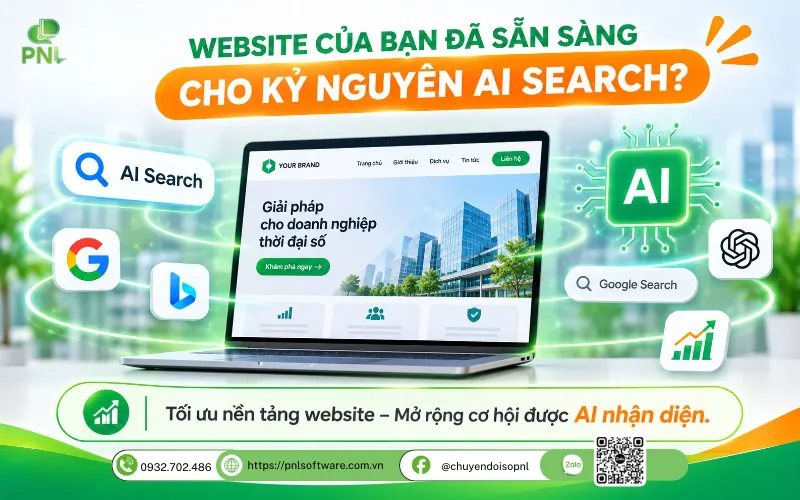
Users' information search behavior is changing as artificial intelligence tools such as ChatGPT, Gemini and Google AI Overview are increasingly used. Instead of searching and visiting many websites themselves, users can ask questions directly to receive aggregated answers.
This change opens up a new optimization direction for businesses: GEO (Generative Engine Optimization). So what is GEO and what do websites need to prepare to adapt to AI search trends?
I. What is GEO?
GEO (Generative Engine Optimization) is a method of optimizing content and brand information to increase the likelihood of being recognized, referenced and cited in answers by generative search engines.
If traditional SEO focuses on improving visibility on search results pages, GEO aims to help AI systems properly understand the information, context and value that businesses provide.
These two methods do not replace each other but can be combined to expand the ability to reach customers on many search platforms.
II. Why is the website an important foundation in the GEO strategy?
Quality content is essential, but for search engines and AI to understand that content, the website needs to have the right technical foundation.
A website with an unclear structure, slow loading speed, or inconsistent data can make it difficult to gather and interpret information.
Enterprises need to focus on three factors:
2.1. Search engine friendly technical structure
Website needs to have a clear navigation system, reasonable source code, good page loading speed and the ability to allow appropriate bots to access content.
2.2. Standardize semantic data
Schema Markup and Entity help better describe businesses, products, services and relationships between information. This is the basis to help search engines understand content more accurately.
2.3. Structured content system
Content should be organized into topic groups (Topic Cluster), directly answering search needs and providing information with clear origins.
III. What do SEO standard websites need to prepare to adapt to GEO?
To build a platform suitable for AI Search trends, businesses can start from the following checklist:
- Check your website's ability to crawl and index.
- Check URL structure, sitemap and robots.txt.
- Optimize page loading speed and mobile experience.
- Implement appropriate Schema for each content type.
- Standardize business information, products and services.
- Build in-depth, reliable and consistent content.
- Monitor visibility and adjust SEO and GEO strategies.
Note, there is no single technique that ensures a website will be recommended by ChatGPT or Gemini. GEO needs to be deployed synchronously between technical platform, content quality and brand reliability.
IV. PNL Agency – Building a website platform ready for new search trends
At PNL Agency, website design solutions not only aim at a professional interface but also focus on technical foundation and long-term development capabilities.
With the orientation of building SEO-standard websites, businesses can step by step:
- Possesses a clear, easy-to-manage website structure.
- Optimize performance and user experience.
- Developing a content system for SEO.
- Standardize data to help search engines understand business information.
Don't let your website just stop at introducing products and services. Turn your website into a foundation for building a sustainable digital presence for your business.
Contact PNL Agency for advice on SEO standard website design solutions, optimizing technical platforms and development orientation suitable for the AI Search era.