Compare In-house and Outsourced Marketing Department: Which Model is Suitable for SMEs?
Businesses can invest budget in Marketing every month but still encounter slow work progress, inconsistent content, scattered customer data and difficult to measure results. One of the common reasons is that Marketing activities depend too much on a few individuals, instead of being organized into a system with clear strategies and processes.
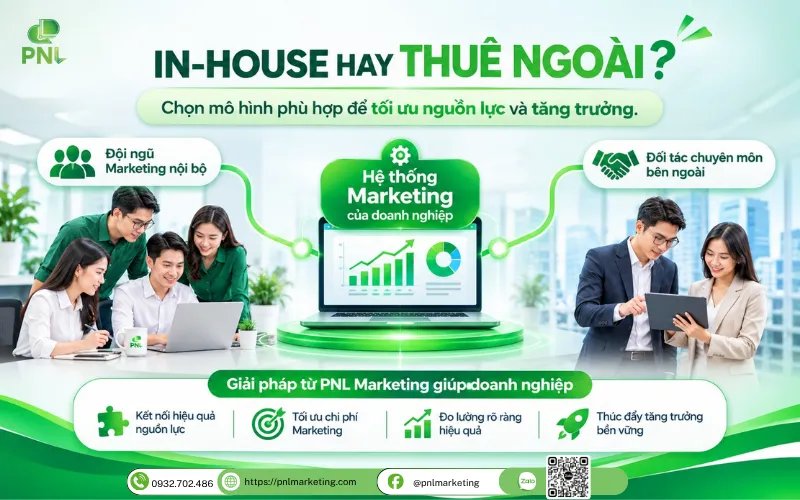
When faced with the choice of building an internal Marketing team (in-house) or collaborating with an outside unit, many businesses often ask the question: which model is more economical? However, for small and medium-sized enterprises (SMEs), the more important problem is how to maintain stable marketing capacity, control resources and ensure that knowledge is not lost when personnel change.
1. Why do businesses need to review their Marketing operating model?
An effective Marketing department doesn't just need people to write content, design images or deploy advertising. This activity also requires strategic direction, phased planning, measurement data and coordination with the business department.
When a business does not have a clear operating system, some problems often appear:
- Depends on the individual: Personnel quitting may take with them plans, accounts, data and implementation experience that have not been fully handed over.
- Lack of consistent professional capacity: One employee must concurrently handle many areas such as SEO, advertising, content, design and channel management.
- Difficult to control costs: Businesses pay salaries and invest in tools but do not clearly determine the effectiveness of each activity.
- Marketing separate from business: There is reach and interaction but no conversion process into potential customers has been formed.
- Lack of inheritance:Newcomers have to start over because there are no unified documents, processes, and stored data.
Therefore, instead of just finding more people to handle the immediate work, businesses need to reconsider how they organize all marketing activities.
2. In-house marketing and outsourcing model: What's the difference?
2.1 In-house marketing: Proactively control and accumulate internal capacity
With the in-house model, businesses directly recruit and manage Marketing personnel. In-house teams have the advantage of understanding the product, customers, culture and business operations. Communicating with the sales department is also convenient, helping market information be updated faster.
This model is suitable when the business has a regular workload, enough budget to maintain a team and has a professional manager. However, if there are only one or two employees, it is difficult for a business to fully cover specialized areas. Recruiting, training and retaining personnel also takes time and resources.
In particular, if knowledge only lies in the experience of each individual, the business can still lose continuity when key personnel leave.
2.2 Outsourcing model: Adding capacity and deployment resources
When cooperating with external units, businesses can access many professional groups such as strategy, SEO, content, website, Social Media and customer care automation without having to recruit all positions.
The advantage of this model is the ability to add capacity according to need and each period. However, outsourcing does not mean giving all Marketing responsibility to a partner and then waiting for results. Businesses still need a focal point to coordinate, provide information, unify goals and control data.
Without reporting, storage and handover processes, businesses can switch from depending on internal personnel to depending on external partners.
3. Cost comparison: Need to consider both operating costs and disruption risks
To choose the appropriate model, businesses should not only compare total personnel salary with cooperation fees. It is necessary to consider all costs to maintain Marketing activities.
| Criteria | In-house | Outsourcing |
|---|---|---|
| Human Resources | Salary, bonus, insurance, recruitment | Budget according to scope of cooperation |
| Training | Self-organized business | Can take advantage of partner's expertise |
| Tools | Enterprise investment and management | According to cooperation agreement |
| Management | Need to manage direct team | Need focal point for coordination and acceptance |
| Expand capacity | Dependent on recruitment | Adjust scope according to needs |
| Inheriting knowledge | Need internal processes | Need to clearly define storage and handover |
For example, a business has two Marketing personnel but still has to hire additional people to run ads, design or implement SEO. Then, the actual total cost includes internal salaries, outsourcing fees, tools and management time.
Conversely, a low-cost collaboration package that does not include strategy, measurement, data storage or transfer is not necessarily the optimal solution.
Businesses should evaluate according to three questions:
- With the current budget, what Marketing capabilities does the business possess?
- Which steps are lacking expertise or causing disruption to operations?
- After an investment period, does the business have the processes and data to continue operating?
4. When should you choose in-house, outsourcing or a combination?
There is no one model that fits all businesses. The choice should be based on scale, goals and current capacity.
In-house should be prioritized when:
- Enterprises have a stable and large enough amount of Marketing work.
- Products and services need a team to closely follow daily business activities.
- There is a professional manager and a budget to maintain long-term personnel.
- Enterprises want to develop Marketing capacity into a core department.
Should consider outsourcing when:
- Businesses do not have enough resources to build a full team.
- Need additional expertise in SEO, website, advertising or content.
- Human resource fluctuations cause frequent interruptions to Marketing plans.
- Need to standardize strategies, processes and measurement systems.
Should be combined when:
The enterprise already has internal personnel but lacks expertise in some stages. Personnel in the enterprise can be in charge of product information, business coordination and target control; External partners support strategic planning, deployment of expertise and process transfer.
This is an option worth considering for SMEs that want to both maintain initiative and add capacity without needing to expand their apparatus too quickly.
5. Sustainable solution: Building a Marketing system that does not depend on an individual
No matter which model you choose, businesses need to shift from doing each job to a system-based way of operating. A scalable Marketing system should have at least five components:
First, clear strategies and goals. Each activity needs to be associated with specific goals such as increasing awareness, attracting potential customers, supporting sales or taking care of old customers.
Second, the implementation process is unified. From customer research, content planning, approval, publishing to effective tracking, everyone needs to be in charge and have a timeline.
Third, data is stored centrally. Website accounts, advertising, social networks, customer data and reports need to be managed with authority to avoid loss when personnel change.
Fourth, transparent measurement system. Businesses need to track appropriate metrics such as leads, cost per lead, conversion rate and revenue contribution. You can refer to Google Analytics documentation on key events to build a way to measure valuable actions on your website.
Fifth, periodic training and handover. Knowledge should not only reside in personal experience. Plans, documents, operating instructions and results need to be updated so the recipient can continue their work.
Once these components are set up, businesses can change personnel or partners without having to rebuild the entire operation from scratch.
6. PNL Marketing: Accompanying to build inheritable Marketing capacity
PNL Marketing approaches a business's problem from its current operating status, business goals and actual resources. Instead of assuming that businesses need to outsource everything, the solution needs to clearly determine which stages should be kept in-house, which stages need additional expertise, and which processes need to be standardized.
Depending on needs, the roadmap may include building an SEO-standard Website, developing Social Media, connecting Zalo Mini App and Zalo OA, managing customer data, applying Content SEO AI or establishing a Marketing - Sales coordination process.
More importantly, businesses need to be guided on how to monitor, administer and continue to use deployed systems. That is the foundation for Marketing activities to not be disrupted when personnel change and gradually improve autonomy.
Conclusion
PNL Marketing accompanies businesses to analyze bottlenecks, design roadmaps and build Marketing solutions suitable to actual resources. The goal is not only to maintain jobs today, but also to help businesses have the ability to operate and develop in the long term.
-----------
🚀 PNL – Upgrading your business
📞 Hotline: AI assistant - 039 86 52281 / or expert 0932 702 486
💻 Software website: https://pnlsoftware.com.vn
🌐 Marketing solution website: https://pnlmarketing.com/
💬 Zalo OA: https://zalo.me/chuyendoisopnl
📱 Tiktok: @pnlchuyendoiso
🛍️ Miniapp Zalo store template: https://shop.pnlmarketing.com/